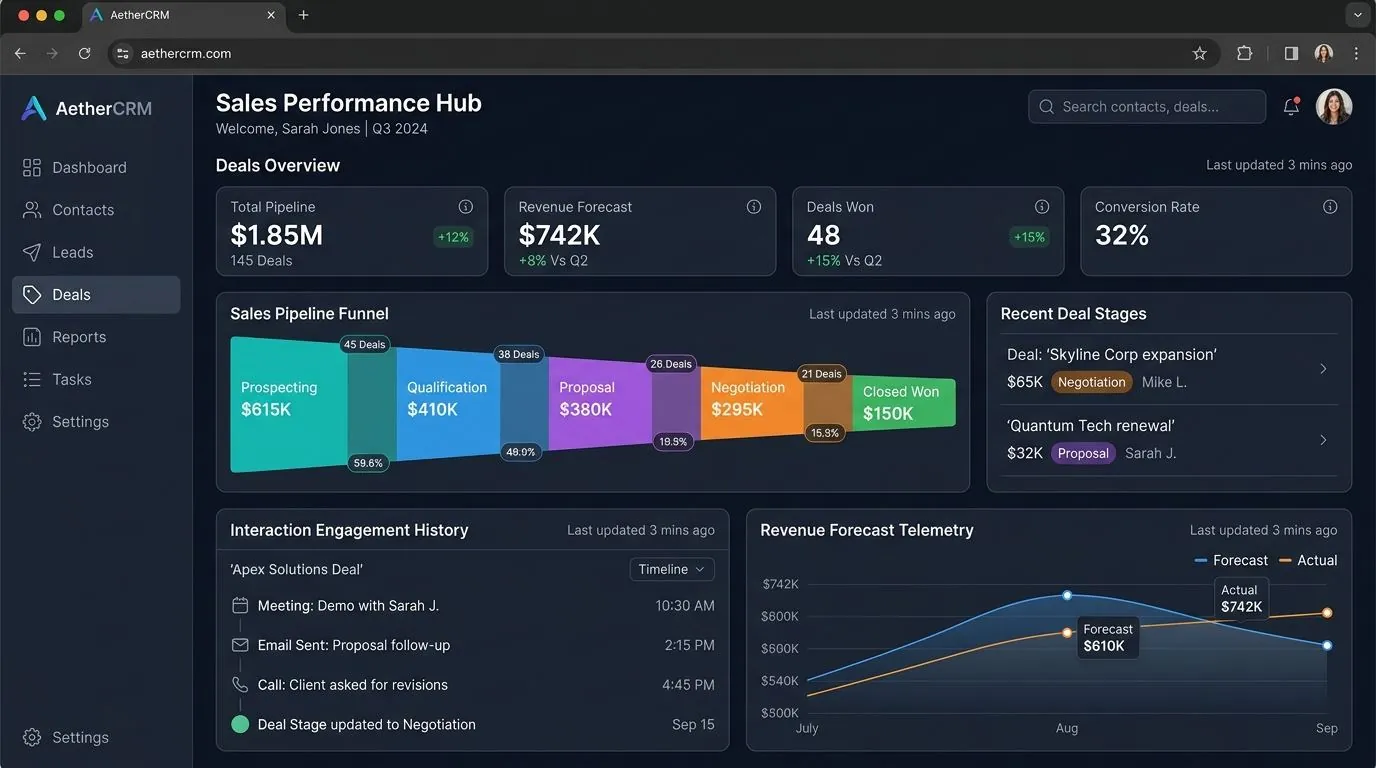
A customer relationship management (CRM) app for sales teams: pipeline stages, automatic call and email logging, and reports in under 250ms. Lead tracking efficiency rose 45%.
Overview
What this is and why it matters, in plain English.
A customer relationship management (CRM) app for sales teams: pipeline stages, automatic call and email logging, and reports in under 250ms. Lead tracking efficiency rose 45%.
A sales CRM that logs every call and email automatically, so leads stop slipping through the cracks.
The situation
What was going on before, and why it needed fixing.
Sales communication lived in personal inboxes and spreadsheets. Leads were lost between reps, nobody could see who last spoke to a customer, and satisfaction reporting was pieced together by hand.
Disorganized sales communication channels led to lost leads, lack of interaction accountability, and disjointed customer satisfaction reporting.
What it needed to do
The outcomes the project had to deliver.
- Log every customer interaction automatically.
- Track each lead through clear pipeline stages.
- Keep each team’s leads isolated and give managers fast reports.
What I did
My part of the work and who I worked with.
I built the Laravel application and its data-isolation middleware, the pipeline and interaction models, the reporting queries, and the RESTful webhook integrations for email and calendar. Work was tracked in JIRA.
How it works
The main building blocks, from the screen people use to the data underneath.
Created an intuitive management portal with automated interaction logging, pipeline stage tracking, and customized Laravel middleware enforcing data isolation.
- 01
Bootstrap and JavaScript front end
Pipeline board, lead profiles with interaction history, and analytics dashboards.
- 02
Laravel core
Leads, contacts, stages and interactions, with custom middleware that scopes every query to the user’s tenant.
- 03
Webhook integrations
RESTful webhooks from email and calendar providers create interaction records automatically.
- 04
MySQL reporting
Aggregation queries for monthly revenue trends and conversion rates, shaped for fast report generation.
Key choices and trade-offs
Every build involves trade-offs. These are the important ones and what each one cost.
| Decision | Trade-off |
|---|---|
| Tenant scoping in middleware and global query scopes. | Cross-tenant admin features need explicit opt-out, but accidental leaks are prevented by default. |
| Webhooks over manual logging. | More integration surface to maintain, but reps no longer have to remember to log calls and emails. |
Under the hood
Implementation details for technical readers, with a code sample.
- Automatic interaction logging from email and calendar.
- Lead tracking efficiency up 45%.
- Reports generated in under 250ms.
// Lead Stage Transition Pipeline with Automated Customer Engagement Tracking
public function transitionLeadStage(Lead $lead, string $newStage, ?string $notes) {
    $previousStage = $lead->stage;
    $lead->stage = $newStage;
    $lead->save();

    LeadActivity::create([
        'lead_id' => $lead->id,
        'user_id' => Auth::id(),
        'from_stage' => $previousStage,
        'to_stage' => $newStage,
        'notes' => $notes
    ]);
    NotificationService::notifyAccountExecutive($lead);
}
Problems solved
What got in the way, and how each problem was fixed.
- 01
Enforcing strict tenant isolation to prevent sensitive sales leads leaks.
Custom Laravel middleware and global scopes that bind every query to the tenant, giving 100% data security compliance.
- 02
Building reactive analytics dashboards aggregating monthly revenue trends and conversion rates.
Pre-shaped aggregation queries for revenue and conversion dashboards, so reports return in under 250ms.
- 03
Integrating email and calendar synchronization with RESTful API webhooks.
Webhook endpoints for email and calendar events that create interaction records on the right lead.
Security, speed and growth
How data is protected, and how the system stays fast as usage grows.
Security
Tenant isolation enforced in middleware and query scopes, authenticated webhook endpoints, and role-based access to reports.
Speed & growth
Report generation stays under 250ms through indexed aggregation queries tailored to each dashboard.
Quality and releases
How changes were tested and shipped safely.
Isolation tests attempt cross-tenant reads and assert they fail. Webhook handlers are tested with sample provider payloads, and report queries are checked against known datasets.
Tech stack
The tools and technologies used, for recruiters and technical reviewers.
Results
Measured outcomes recorded for this project.
| Metric | Result |
|---|---|
| Lead Tracking Efficiency | +45 % |
| Report Generation | <250 ms |
| Data Security Compliance | 100 % |
Questions
Plain answers first, then the detail a technical reviewer would ask about.
Common questions
- How does this help a sales team?
- Calls and emails are logged automatically, every lead has a clear stage, and reports load in under 250ms. Lead tracking efficiency rose 45%.
- Can it replace our spreadsheets?
- That is exactly the job it was built for: one shared system instead of copies of a spreadsheet that disagree.
For your tech lead
- How are leads kept private between teams?
- Middleware and global query scopes bind every query to the user’s tenant.
- Do reps log interactions by hand?
- No. Email and calendar webhooks create interaction records automatically.
Key takeaways
- •A sales CRM that logs every call and email automatically, so leads stop slipping through the cracks.
- •Built with Laravel, Bootstrap, JavaScript, MySQL, RESTful APIs, JIRA.